Glowing sensors for DNA
07/28/2026How can the most subtle processes in our genetic material be made visible? A graduate of the University of Würzburg has developed an innovative approach to this – and has now been awarded a prize for her outstanding final thesis.
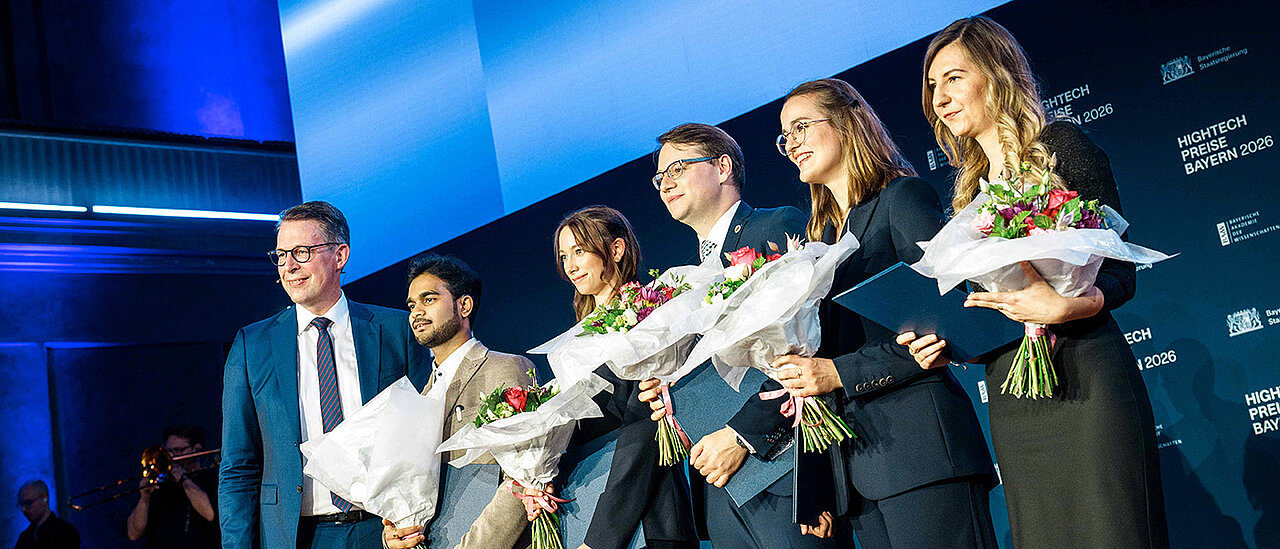
On 23 July 2026, the Bavarian State Government, in conjunction with the Bavarian Academy of Sciences, presented the Bavarian High-Tech Awards 2026. Among the award winners is a graduate of Julius-Maximilians-Universität Würzburg (JMU): chemist Sarah Lutz received the prize, worth 2,000 euros, for her research into boron-nitrogen doping.
Sarah Lutz is interested in biological processes taking place inside cells. To understand these, researchers use molecular ‘light signals’: so-called fluorescent markers. These can be incorporated into DNA and, depending on their immediate surroundings, glow when exposed to special light. This makes it possible to track what is currently happening in the genetic material.
Boron and nitrogen as a chemical trick
The problem with previous markers is that, in certain cases, they are not sensitive enough to detect small changes in their environment. This is where the award-winning work at the interface of inorganic chemistry and chemical biology comes in.
Sarah Lutz used special organic compounds, known as phenalenyls, and modified them using a specific chemical trick: she incorporated the elements boron (B) and nitrogen (N) into their structure. This so-called BN doping positively alters the optical properties of the molecules – resulting in novel dyes whose interaction is expected to provide access to more precise information.
A molecular warning system
In her work, the graduate succeeded in stably coupling these novel molecules to nucleosides – the fundamental building blocks of DNA. Within the genetic chain, the compounds function as a precisely coordinated pair:
- The signal emitter (fluorophore): emits a light signal.
- The quencher: suppresses this signal as soon as it comes too close to the signal emitter.
As this pair is highly sensitive to the distance between them, it functions like a molecular warning system: if the environment or the structure of the DNA changes, the distance between the two building blocks changes – the signal transmitter’s glow is switched on and off, thereby providing information about structures and processes.
Through her work, the Würzburg graduate has demonstrated that BN-doped building blocks show great potential for use as highly sensitive biosensors. Such tailor-made molecular tools form an important basis for the development of modern medical and scientific methods, with the aim, for example, of being able to detect genetic changes at an early stage in the future or to develop novel DNA-based materials.
Sarah Lutz’s career
Sarah Lutz is from Coburg; she completed her Bachelor’s degree in Chemistry at the University of Würzburg from 2019 to 2022 and her Master’s degree from 2022 to 2024. Since January 2025, she has been conducting research at the Chair of Inorganic Chemistry I as part of her PhD; her supervisor is Professor Holger Helten, who holds the chair.
She has already received several awards for her achievements, including the Society of the German Chemical Industry’s award for outstanding achievement in the school subject of chemistry (GDCh) in 2019, as well as the Faculty of Chemistry Prize from the Keck-Köppe Foundation for the best Master’s degree of her year at JMU Würzburg and the Kekulé Scholarship from the German Chemical Industry Association in 2025.
Bavarian High-Tech Awards in three categories
For the second time, the Bavarian State Government, in collaboration with the Bavarian Academy of Sciences (BAdW), has honoured pioneering research and groundbreaking innovations. The Bavarian High-Tech Awards are presented in three categories and recognise promising young talent as well as outstanding scientists. According to Germany’s Ministry of Science, they are the most highly endowed technology prizes.
Minister for Science Markus Blume congratulated the winners: “Congratulations to our prize-winners: your excellent work has a direct impact on our everyday lives. You prove once again that Bavaria’s universities are hotbeds of innovation and problem-solvers.”
Further information is available here