The quest for the universal catalyst
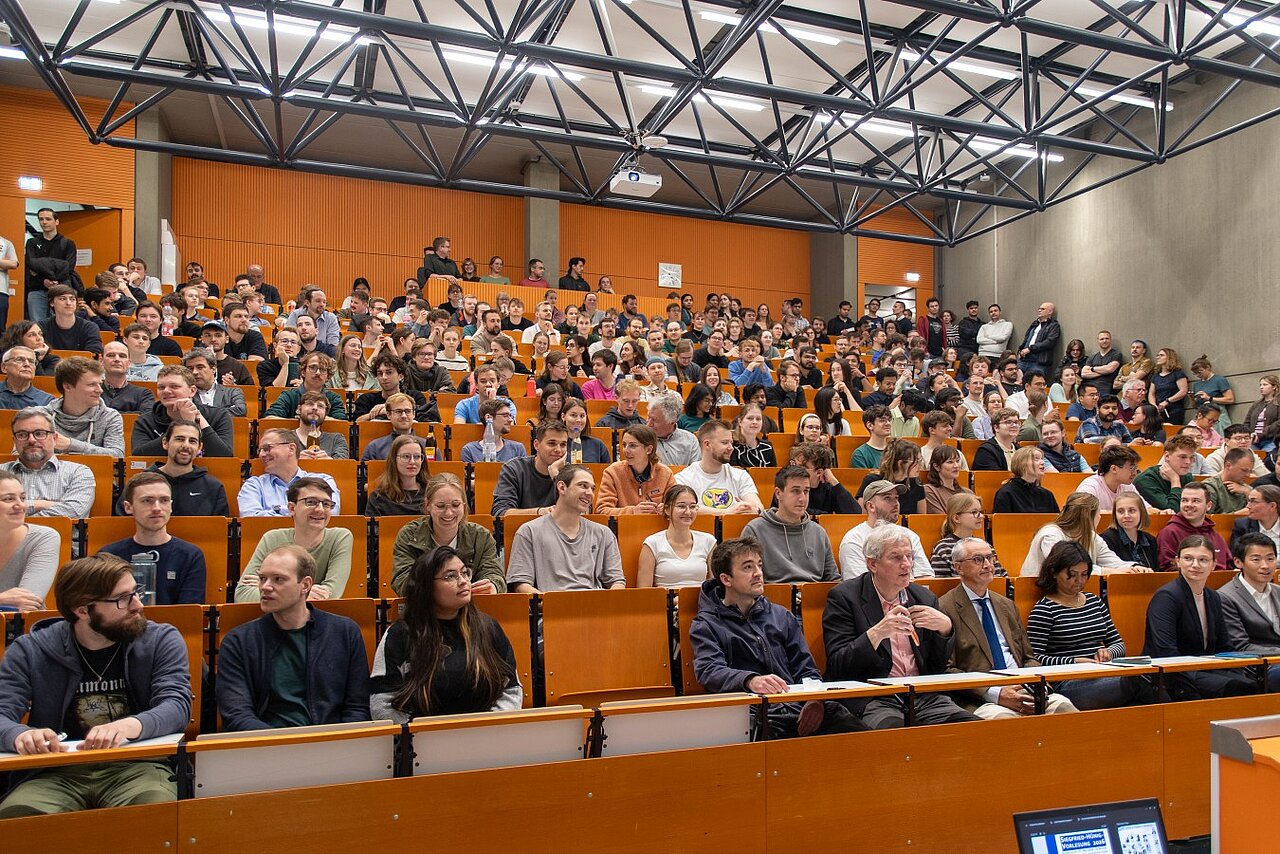
05/08/2026And for a seat! In the packed Lecture Hall B, Benjamin List, 2021 Nobel Laureate in Chemistry and winner of the 2026 Siegfried Hünig Lecture, took the more than 200 attendees on an exciting journey.
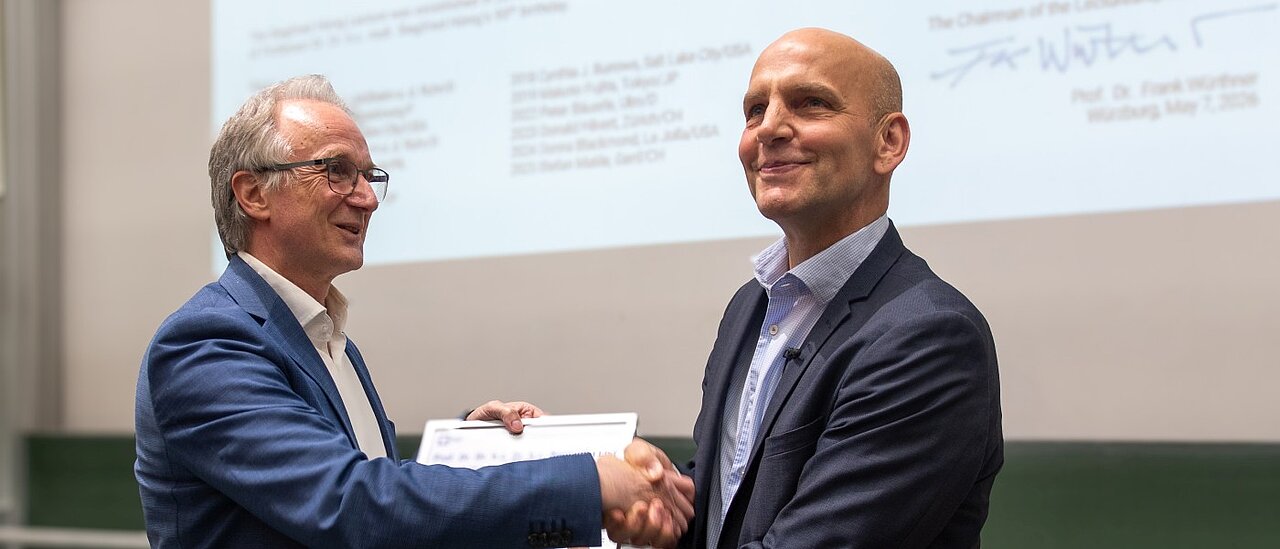
Lecture Hall B in the Chemistry Centre at Hubland, which was designed by Siegfried Hünig in the 1970s, has rarely been as full as it was on 7 May 2026. The opportunity to experience a German Nobel laureate live was obviously something many people wanted to take advantage of, even if they had to make do with standing room only. However, host Frank Würthner showed in his introduction that some people have missed out on a lot over the past 15 years. After all, the winners of the Siegfried Hünig Lecture, which was launched in 2011, have always been particularly outstanding scientists, including Nobel Prize winners.
Chemistry explains the world
Benjamin List, Director at the long-established Max Planck Institute for Coal Research in Mülheim since 2005, skilfully followed on from Frank Würthner's introduction, which included a historical review, and dedicated the first few minutes to his early career and motivation. He described how, as a schoolboy, the impression that only chemists could explain the world led him to study chemistry. An impression that he soon realised was not entirely correct. However, this realisation came too late, he said with a wink and had the laughs on his side. Chemistry had quickly captivated him, especially organic synthesis.
Decisive breakthrough as a postdoc in the USA
As part of his doctoral thesis with J. Mulzer, Benjamin List spent more than four years working on the multi-stage total synthesis of a substructure of vitamin B12. A tough test of patience, but one that he successfully passed and which only increased his motivation, especially as other researchers succeeded in the one-pot synthesis almost simultaneously. They had used a cocktail of enzymes - natural catalysers - instead of classic organic synthesis chemistry. As a postdoc at the renowned Scripps Research Institute in La Jolla, List then achieved the decisive scientific breakthrough when he attempted to use small amino acids to achieve what evolution had produced highly complex enzyme structures for. His publication on the use of the amino acid proline as a catalyst in an asymmetric intermolecular aldol reaction appeared at the beginning of 2000.
Catalysis for our World
Benjamin List consistently developed this approach further, which is why he - together with David W. C. MacMillan - is regarded as the founder of organocatalysis, for which both were honoured with the Nobel Prize. Catalysts from his laboratories have now enabled a large number of - mostly asymmetric - syntheses that either do not work at all with metal-containing catalysts or enzymes or are less economical or less ecological. These include the synthesis of fragrances such as β-santalol (in sandalwood oil) and the ambergris component ambrox. This requires a certain fine-tuning of the catalyst structures. The more open the structure, the more universal the catalyst. However, for stereochemically complex target molecules, a stronger structural restriction is usually required. However, even the structurally simple proline, with which everything began in La Jolla in 1999, has since served mankind well as a universal catalyst. This is because it enabled the large-scale production of the HIV drug Darunavir, an essential medicine according to the World Health Organisation (WHO).
The Siegfried Hünig Lecture
The Siegfried Hünig Lecture was established in 2011 to mark the 90th birthday of Prof Dr Dr h.c. mult. Siegfried Hünig. An internationally renowned chemist is invited to give a lecture in Würzburg once a year as part of this named lecture.
Weblinks
Homepage of the List working group at the MPI for Coal Research
Additional images