M. A. Niyas receives SupraChem PhD Award 2026
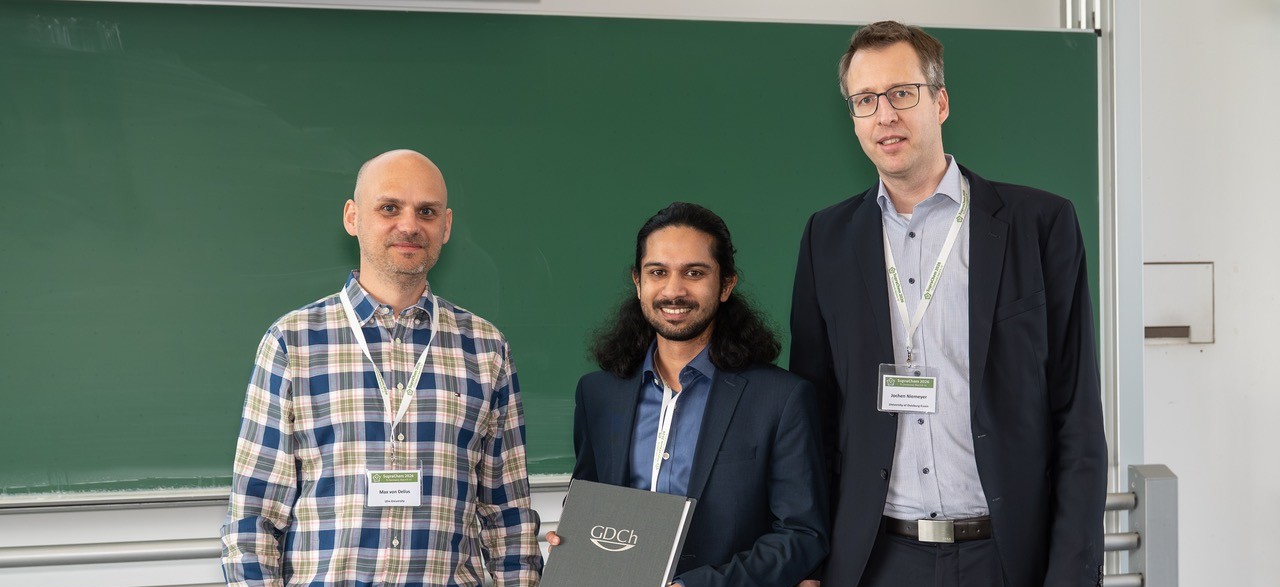
03/13/2026Niyas Mundakkamattathil Abdul Salam, former PhD student at the Würzburg Faculty of Chemistry and Pharmacy, received one of the two PhD awards in memory of Carsten Schmuck at SupraChem 2026.
It was only last year, that the GDCh (German Chemical Society) established the Supramolecular Chemistry Working Group which now takes responsibility for organising the biennial SupraChem conferences and awards two prizes for outstanding doctoral theses in the field of supramolecular chemistry completed at research institutions in Germany.
PhD prize in memory of Carsten Schmuck
The SupraChem PhD Prize is dedicated in memory of Professor Carsten Schmuck (1968-2019), former Professor at the Institute of Organic Chemistry in Würzburg, later Chair at the University of Duisburg-Essen and initiator of the first SupraChem conference in Essen in 2011. The prize can be seen as the German equivalent of the established British Macrocyclic and Supramolecular Chemistry (MASC) Thesis Award, which was recently awarded to Jiarong Wu, who also completed her doctorate in Würzburg (Greenfield group).
One of the two PhD awards for the years 2024 and 2025 goes to Niyas Mundakkamattathil Abdul Salam, a former doctoral student in Frank Würthner's group. He completed his dissertation entitled "π-Stacked Supramolecular Complexes of Nanographene Multiimides" at the end of 2024.
Doctorate with outstanding publications
Coming from IISER Thiruvananthapuram, India, where he received his MSc in Chemistry, M. A. Niyas showed exceptional skill and dedication to involve in a variety of exciting projects during his PhD, with four first-author publications in top-tier journals. He worked on large nanographene host systems for the binding of polycyclic aromatic hydrocarbons (Nat. Chem. 2022, J. Am. Chem. Soc. 2024), pigments (Angew. Chem. 2023), NIR phosphorescence sensitisers (Angew. Chem. 2024), and halide ions (Nature 2025). The latter work is considered as particularly important as it demonstrated for the first time that a hole created by one missing benzene unit within a nanographene layer is sufficient to enable the barrierless penetration of fluoride as well as chloride and bromide, but not iodide. These insights might accordingly stimulate the fabrication of desalination membranes based on perforated ultrathin graphene membranes.
Niyas is currently in Oxford on a Newton postdoctoral fellowship with Prof. Molly Stevens and recently got awarded a Marie-Curie fellowship to continue his research there for a total of four years.