Leading researcher from Japan joins Würzburg chemistry
03/31/2026Highly renowned guest at the University of Würzburg: Chemistry professor Makoto Fujita from Tokyo joins Professor Frank Würthner's team as a Humboldt Research Award winner.
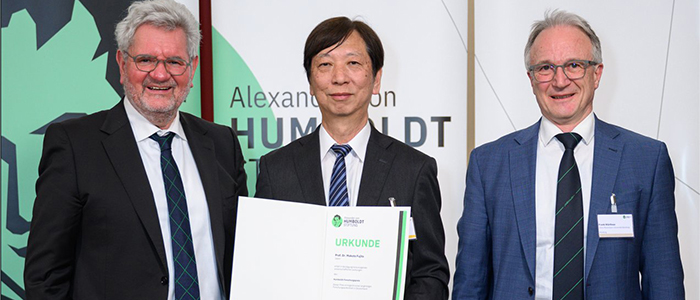
Researchers at the Center for Nanosystems Chemistry (CNC) at the University of Würzburg can look forward to a renowned guest: from 26 April 2026, chemist Professor Makoto Fujita from the University of Tokyo will be spending six months in Würzburg. He is being funded by one of the Alexander von Humboldt Foundation’s prestigious research awards.
Makoto Fujita is a pioneer in metallosupramolecular chemistry: this field deals with molecules that assemble into larger complexes by means of coordinative bonds – and which can then often perform very specific functions.
Cages and networks with small cavities
In 1990, the Japanese professor synthesised the first molecular square by coordinating 4,4'-bipyridine units at Pd(II) corners. Building on this, he and his group were able to construct enormous polyhedra from the simplest building blocks in the following decades.
The key feature of these large molecules is that they form cavities in which other molecules can be enclosed as if in a small box. This opens up many possible applications – for example, as sensors for harmful substances or in catalysis as artificial reaction chambers in which chemical reactions proceed faster or cleaner.
Professor Frank Würthner, CNC Director and Chair of Organic Chemistry II, nominated the Japanese scientist for the Humboldt Research Award: "I am delighted that Professor Fujita will be enriching our team for six months! His cage compounds could be suitable as matrix materials for our International Research Training Group on ‘Photoluminescence in Supramolecular Matrices’.”
Researcher with unbroken creative power
Over the years, Makoto Fujita has continuously produced new metallosupramolecular structures whose realisation was previously considered difficult to impossible by experts.
In addition to his groundbreaking work on metallosupramolecular squares and polyhedra, he was also one of the first to realise coordination networks in the 1990s. In 2013, he introduced the “crystalline sponge method”. This technique allows molecules that cannot be crystallised or are only present in trace amounts, such as natural substances, to be incorporated into the porous crystalline matrix of metallosupramolecular polyhedra. The structure of the unknown molecules can then be determined from the crystallographic data that become available.
The creative power of Makoto Fujita, born in 1957, remains unbroken to this day: as Distinguished Professor at the University of Tokyo Institute for Advanced Study, he is working to open up new areas of research and demonstrate innovative applications of supramolecular chemistry. The title of Distinguished Professor is only awarded to selected individuals at the University of Tokyo who have made outstanding international contributions to research.
Joint research at JMU
For Makoto Fujita's six-month stay at JMU, collaboration on two research topics has been agreed.
Fluorescent dye stacks:
The first project investigates π stacks. These are composed of dye molecules arranged on top of each other that have special luminescent properties. Würzburg doctoral students and postdocs are interested in embedding their dyes in Makoto Fujita's polyhedral cages and using them to develop new materials for organic light-emitting diodes (OLEDs).
Structural analysis of large molecules:
Several groups at the CNC work in crystallography, i.e. on deciphering complex molecular structures. As Makoto Fujita has extensive experience in this field with very large metallo-supramolecular cages, the teams expect to gain insights into methodological advances and practical experience in crystal growth.
About the Center for Nanosystems Chemistry
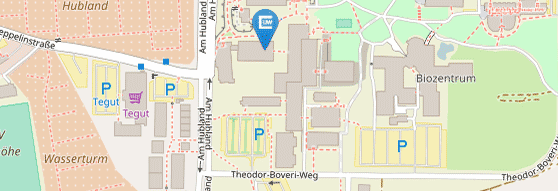
During his stay at the University of Würzburg, Professor Fujita will have his office at the Center for Nanosystems Chemistry.
The centre was founded in 2016 by the Free State of Bavaria as a KeyLab for supramolecular materials for the conversion of solar energy. It is part of the joint research programme “Solar Technologies Go Hybrid” (SolTech) of five Bavarian universities (Bayreuth, Erlangen-Nuremberg, LMU and TU Munich, Würzburg), which currently receives funding for around 30 doctoral students until the end of 2026.
The CNC also hosts all events of the International Research Training Group IRTG 2991 “Photoluminescence in Supramolecular Matrices”, which the University of Würzburg established in collaboration with the Indian Institute of Science Education and Research (IISER) Thiruvananthapuram.
Contact
Prof. Dr. Frank Würthner, frank.wuerthner@uni-wuerzburg.de