
Dr. Reich Lecture 2025 & GDCh Colloquium
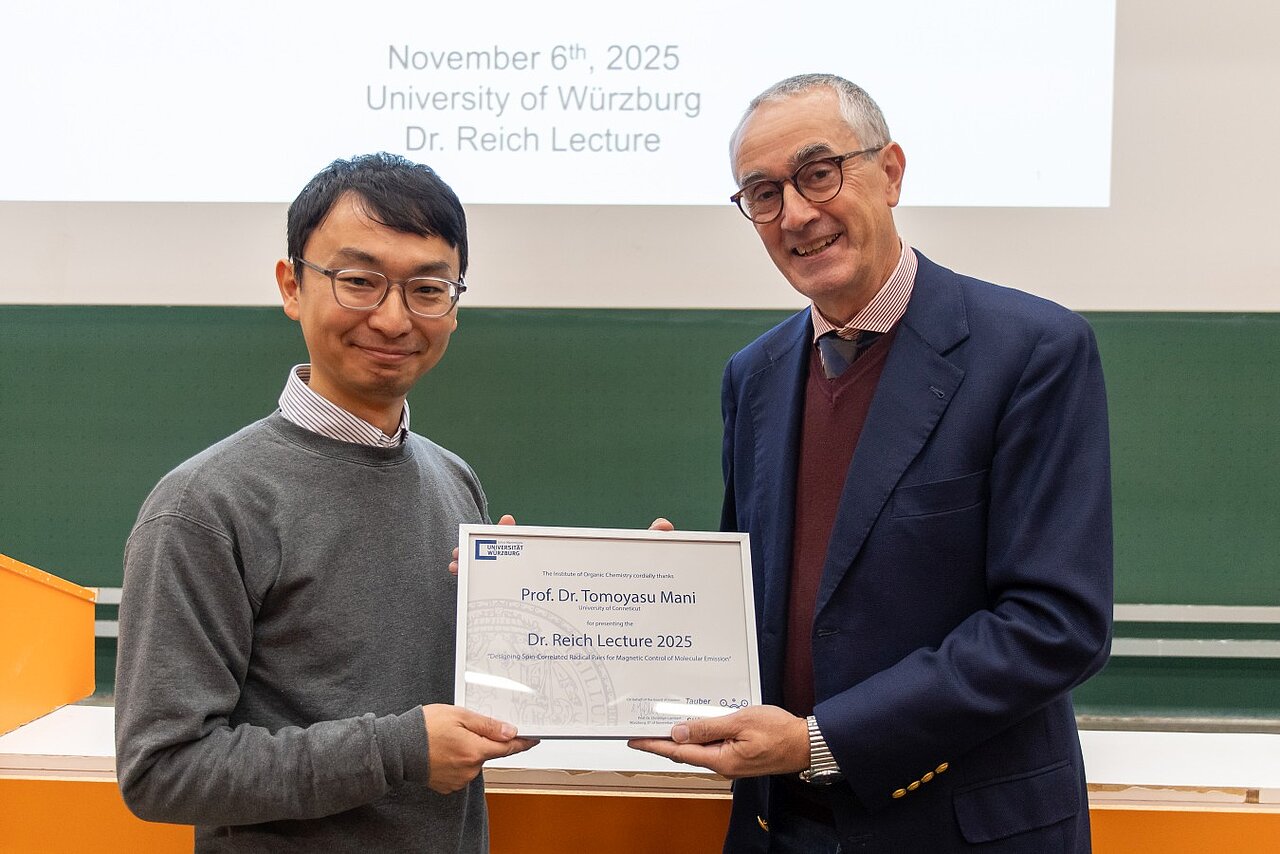
11/06/2025Professor Tomoyasu Mani from the University of Conneticut will give a lecture on "Designing Spin-Correlated Radical Pairs for Magnetic Control of Molecular Emission" on 6 November 2025 at 14:15 in Lecture Hall C
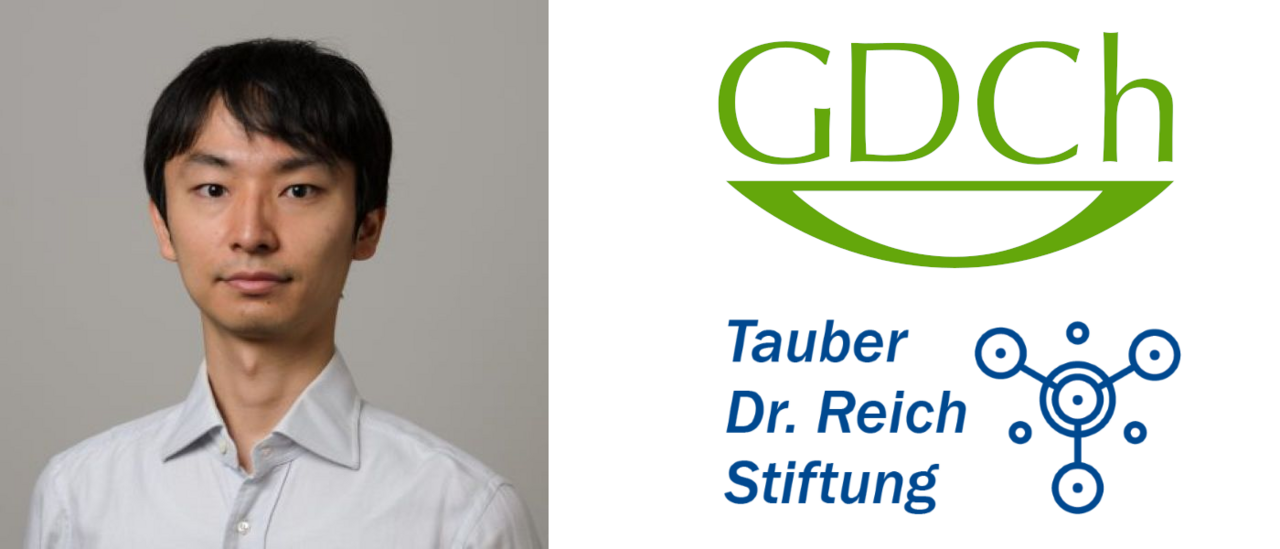
The Lower Franconia branch of the GDCh and the Tauber Dr. Reich Foundation present a lecture on Thursday, 6 November 2025 at 2:15 pm in Lecture Hall C (Central Chemistry Building).
Professor Dr Tomoyasu Mani, University of Connecticut, USA will talk about
"Designing Spin-Correlated Radical Pairs for Magnetic Control of Molecular Emission"
and will be awarded the Dr Reich Lecture 2025.
We are very much looking forward to welcoming you.
Abstract:
Photogenerated spin-correlated radical pairs (SCRPs) offer a unique molecular platform for manipulating spin states and reactivity under weak magnetic fields.1 Such spin-dependent photochemical processes bridge molecular photophysics with quantum information science (QIS), where coherent spin dynamics underpin the development of new technologies.
This talk will focus on how synthetic molecular design enables magnetic control of excited-state dynamics and emission through SCRP-based mechanisms. I will first introduce the fundamental principles of spin chemistry, including radical-pair formation, spin evolution, and spin-selective recombination, to show how photoexcitation generates non-equilibrium spin states and how magnetic fields modulate chemical reactivity.
Building on these fundamentals, I will then present our recent progress in the synthetic spin chemistry of donor-bridge-acceptor (D-B-A) molecules that display exceptionally large magnetic field effects (MFEs) on both fluorescence intensity and lifetime at room temperature. Through synthetic control over molecular architecture, including torsional rigidity, donor-acceptor separation, and conjugation changes, we achieve tuning of charge and spin dynamics.2 Our design strategies enable up to a fourfold enhancement in emission lifetime and a twofold modulation in emission intensity under modest magnetic fields. These results demonstrate that spin-state evolution can persist in soft molecular environments, opening new avenues for molecular design toward optically addressable spin systems and quantum sensors.
I will also describe how magnetic modulation of spin population dynamics can be exploited to control reaction pathways. We demonstrate magnetic-field-responsive triplet-triplet annihilation upconversion (TTA-UC), in which SCRPs act as molecular magnetic switches that amplify MFEs on delayed fluorescence.3 Likewise, we show that magnetic modulation can be transferred from non-emissive ("dark") triplet states to emissive triplets via spin-selective triplet-triplet energy transfer (TTET), enabling magnetic control of phosphorescence.4 Collectively, these results show a molecular-level route for coupling magnetic fields with excited-state reactivity and emission.
Our work establishes a framework for synthetic quantum control, which could advance the integration of molecular systems into the broader landscape of room-temperature quantum technologies.
References:
[1] Mani, Chemical Physics Review, 3, 021301 (2022)
[2] Lin et al, Journal of the American Chemical Society. 147, 13, 11062-11071 (2025)
[3] Lin and Mani, Journal of the American Chemical Society. 147, 9, 7187-7190 (2025)
[4] Lin, Zagajowski, Esipova, and Mani J. Phys. Chem. Lett. 16, 27, 6983-6987 (2025)
Additional images