Breakthrough expands the catalytic and chemical capabilities of RNA
29.05.2026A ribozyme for site-specific N4-Cytidine alkylation was discovered by Evgeniia Dorinova in the Höbartner laboratory at the University of Würzburg.
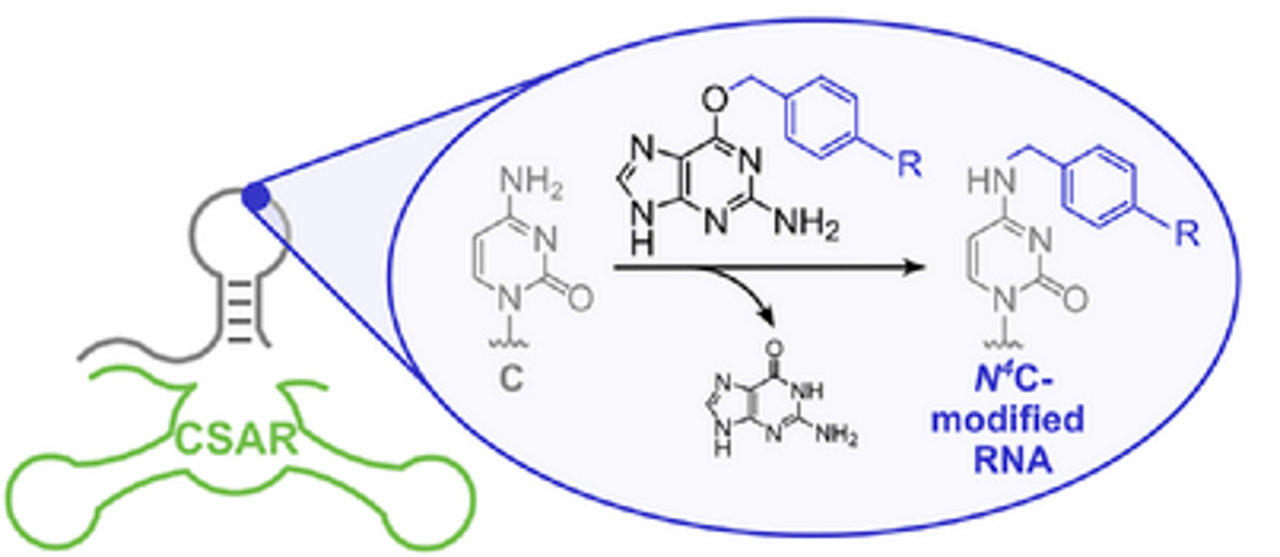
Researchers in the Institute of Organic Chemistry have developed the first ribozyme capable of directly alkylating cytidine at its exocyclic amino group, marking a major advance in RNA catalysis and site-specific RNA engineering. The newly discovered catalyst, named CSAR (Cytosine-Specific Alkyltransferase Ribozyme), enables precise chemical modification of RNA using customizable alkyl donors and opens new opportunities for RNA labeling, imaging, and synthetic biology.
The study demonstrates that RNA itself can catalyze chemical reactions previously thought to require protein enzymes, significantly expanding the known catalytic repertoire of ribozymes.
“CSAR represents an important milestone in the development of RNA-based catalytic technologies,” the authors note. “It is the first ribozyme shown to directly alkylate the exocyclic amino group of a nucleobase.”
Expanding the Ribozyme Toolbox
Ribozymes — catalytic RNA molecules — are increasingly being explored as programmable tools for RNA modification. Until now, most known RNA-alkylating ribozymes targeted adenosine residues at reactive positions that generate positively charged products.
CSAR breaks new ground by catalyzing direct N4-alkylation of cytidine, creating N4-modified cytidine at a precisely defined position within a target RNA hairpin. The reaction uses O6-benzylguanine derivatives as alkyl donors, compounds already widely employed in SNAP-tag protein labeling technologies.
The researchers showed that CSAR can efficiently transfer benzyl groups carrying bioorthogonal handles such as alkynes and azides, enabling subsequent attachment of fluorophores, affinity tags, and other functional molecules through click chemistry.
From Random RNA Library to Precision Catalyst
CSAR was identified through an in vitro selection process using a diverse RNA library that was enriched for self-labeling activity. After multiple rounds of selection and further engineering, Evgeniia Dorinova converted a self-modifying ribozyme into a trans-acting catalyst capable of modifying separate RNA substrates through programmable base-pairing interactions.
Detailed biochemical and mass spectrometric analyses confirmed that CSAR specifically modifies a cytidine in a defined RNA loop structure and generates N4-benzylcytidine products with high selectivity.
Importantly, the ribozyme achieved rapid and efficient labeling under optimized conditions, with some substrate variants reaching nearly quantitative conversion within less than one hour.
A Platform for RNA Labeling and Synthetic Biology
The discovery has immediate implications for RNA biotechnology. By enabling site-specific installation of clickable functional groups, CSAR provides a fully RNA-based platform for targeted RNA labeling without requiring protein enzymes.
Because CSAR operates through programmable RNA-RNA interactions, the system may be adaptable to a broad range of RNA targets.
Insights into the Evolution and Catalytic Power of RNA
Beyond its technological applications, CSAR also deepens understanding of RNA catalysis itself. The work demonstrates that ribozymes can mediate chemically demanding transformations involving exocyclic amino groups — reactions previously considered challenging for RNA catalysts.
The findings support the growing view that RNA possesses far greater catalytic versatility than previously recognized and may inspire future discovery of ribozymes capable of modifying additional nucleobases such as adenosine or guanosine.
Future studies will focus on elucidating the three-dimensional structure and catalytic mechanism of CSAR, which could guide the design of next-generation RNA catalysts with expanded chemical functions.
The work establishes a new frontier in catalytic RNA engineering and highlights the rapidly growing potential of ribozymes as programmable tools for molecular biology and biotechnology.
The discovery of CSAR was reported by Evgeniia Dorinova, Manisha Walunj and Claudia Höbartner and published in Angewandte Chemie International Edition on April 6, 2026.