Synthesis and nonlinear spectroscopy of nanocrystals
In this project, we synthesize a variety of colloidal semiconductor nanocrystals including quantum dots, rods, and nanoplatelets and investigate their photophysical properties using time-resolved spectroscopy. By systematically varying the chemical composition, size, and morphology of the nanocrystals, we are able to tune their excitonic and optoelectronic properties with high precision. In order to achieve specific crystal shapes such as rod-like, or plate-like, we use certain ligands in the synthesis that selectively bind to particular crystal facets, thereby promoting anisotropic growth. The size of the nanocrystals can be adjusted by varying the concentration of the precursor substances as well as the temperature and reaction time. This allows one to adjust the spatial confinement of excitons during synthesis, which, in turn, enables precise control over the optical properties of the nanocrystals.
To investigate the energetic structure and dynamics of exciton states, we use methods of fluorescence-detected coherent multidimensional spectroscopy. The advantage of this spectroscopic method is that background signals from solvents can be effectively avoided, and dynamics can be sampled with a temporal resolution of up to 10 fs. This allows ultrafast correlations to be measured even at room temperature.
Of particular interest is the determination of structure–property relationships with direct relevance to technological applications such as quantum computers. Our spectroscopic methods allow us to measure specific phenomena very selectively. For example, we investigate the extent to which the composition, size, and shape of nanocrystals influence the lifetime of coherent superposition states. Another interesting question is whether the rate of multiexciton generation, which is crucial for the development of efficient solar cells, could be increased through targeted synthesis.
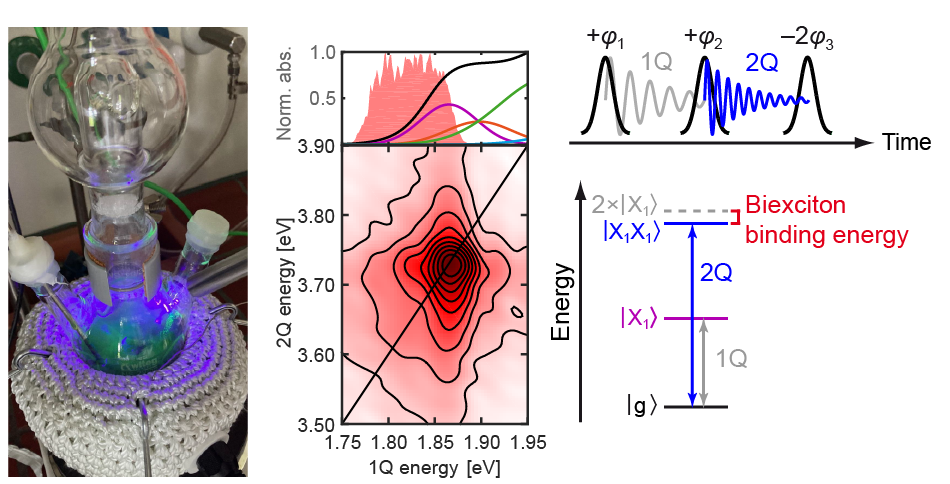
A thesis in this project can cover many areas of work. The focus is on planning and performing time-resolved experiments, which requires the use of lasers and pulse shapers. Depending on the topic of the thesis, the following work areas may be added:
- Synthesis and purification of semiconductor nanocrystals
- Characterization of nanocrystal samples with electron microscopy
- Multidimensional spectroscopy with fluorescence detection
- Pump–probe spectroscopy of multiexcitons
- Programming and control of a laser pulse shaper in LabVIEW
- Assembly of optical setups
If you are interested and have further questions, please contact us!
Contact:
Dr. Vishnu E. Krishnan, vishnu.krishnan@uni-wuerzburg.de
Dr. Stefan Müller, stefan.mueller@uni-wuerzburg.de
Literature for overview:
[1] S. Draeger, S. Roeding, and T. Brixner, Opt. Express 25, 3259–3267 (2017).