AC/DC High Voltage Chemistry
08/08/2025This year's prizewinner, Stefan Matile, impressed his audience at the Siegfried Hünig Lecture 2025 with exciting research results such as supramolecular organocatalysis at 500 V.
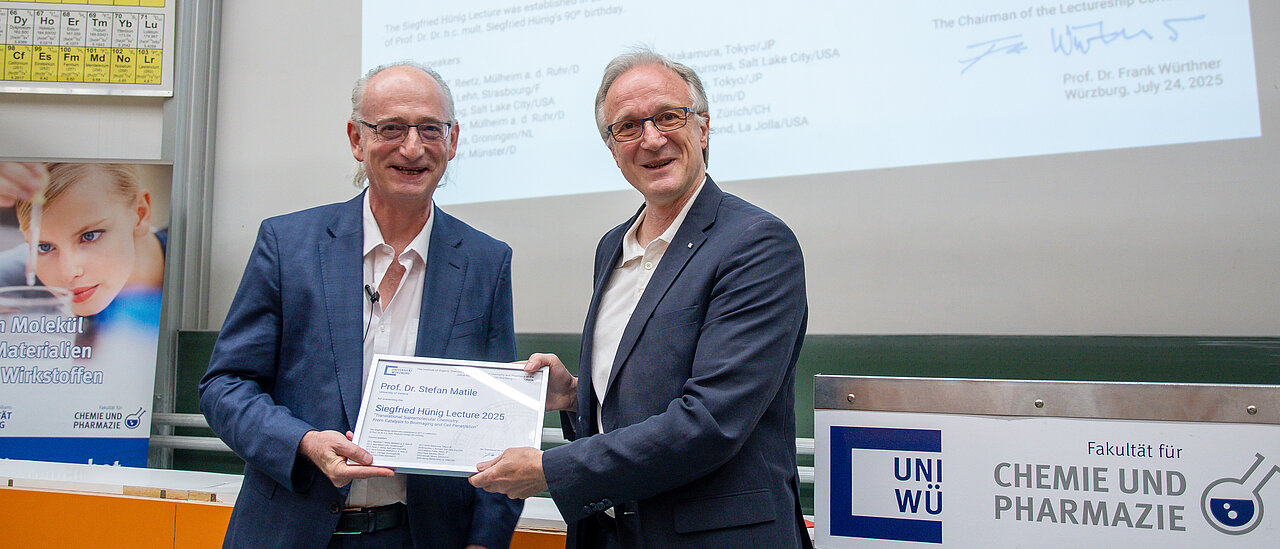
None of his listeners asked Stefan Matile whether he likes listening to Australian hard rock music. But when asked about AC/DC, he explained that both alternating current (AC) and direct current (DC) are equally suitable for achieving an impressive increase in catalytic activity when anion-π catalysts are exposed to a strong external electric field. The applied voltage is up to 500 V. An astonishingly high value compared to classic electrochemical experiments, which is only possible thanks to the clever design of the experiment using a microfluidic cell.
Diverse research as a unifying element
When Prof Matile presented these latest and partly unpublished results towards the end of his very inspiring lecture, he had already covered a wide range of topics in line with the lecture title "Translational Supramolecular Chemistry: From Catalysis to Bioimaging and Cell Penetration" and yet he was only able to mention several of his research areas in very few words. This enormous breadth of research certainly impressed everyone in the well-attended lecture hall B, even if this did not come as a complete surprise. In his welcoming address, the host, Prof. Frank Würthner, had already emphasised how many different links exist between Stefan Matile's research and the equally diverse research of Siegfried Hünig.
The prizewinner
Stefan Matile has been a professor at the Department of Organic Chemistry at the University of Geneva since 1999, following positions at the Columbia University in New York and Georgetown University in Washington DC. In Geneva, he established a field of research at the interface of synthetic organic, biological and supramolecular chemistry with pioneering contributions in translational supramolecular chemistry addressing the topics of synthetic ion channels, artificial photosynthesis, anion-π-interaction, anion-π and sigma-hole catalysis and the development of mechanosensitive fluorescent probes.
The Siegfried Hünig Lecture
Prof. Dr Dr h.c. mult. Siegfried Hünig, born in 1921, was a visionary chemist after whom not only the world-famous Hünig base was named, but who also provided important initial impulses in several areas of physical organic chemistry and, as a passionate university lecturer and institute director, was also formative for the development of the chemical institutes in Würzburg in the second half of the 20th century. He died in 2021 a few days before his 100th birthday and before being included in the "Heroes of Chemistry" section of the journal Angewandte Chemie.
The Siegfried Hünig Lecture was established in his honour during his lifetime in 2011. As part of this named lecture, an internationally outstanding research personality is invited to give a lecture in Würzburg once a year.