
Great public attention for young DNA researcher
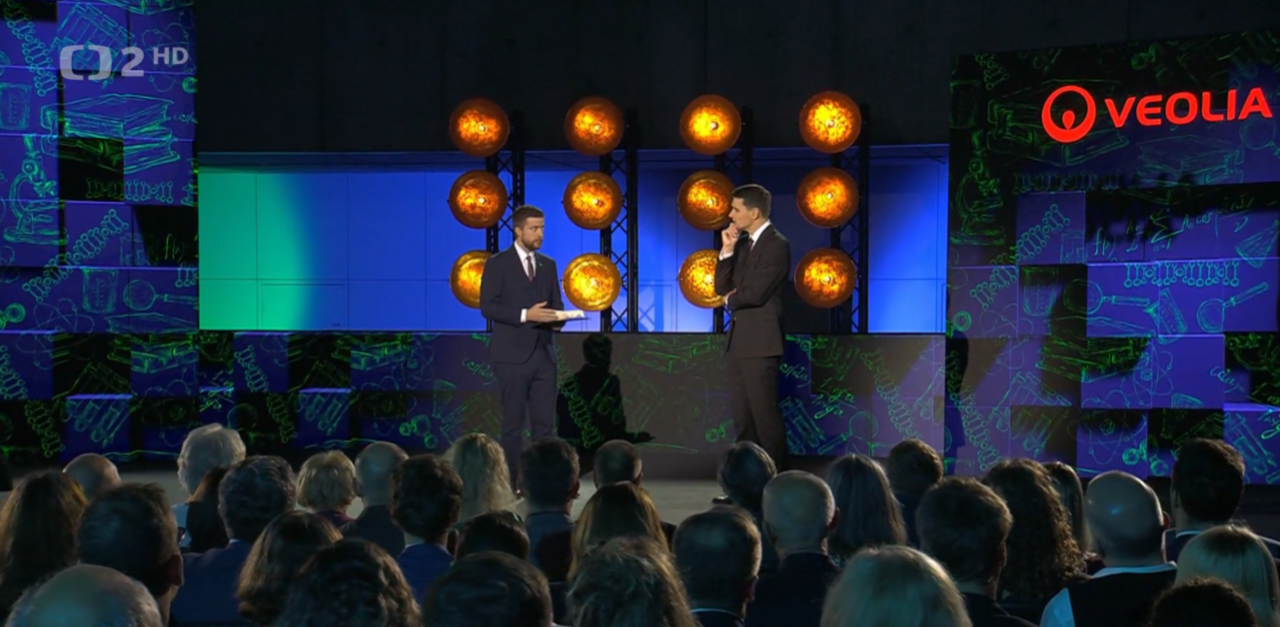
11/20/2025Dr. Martin Volek was awarded the prestigious "Česká hlava" ("Czech Brain") prize, which he received at a gala broadcast on Czech television.
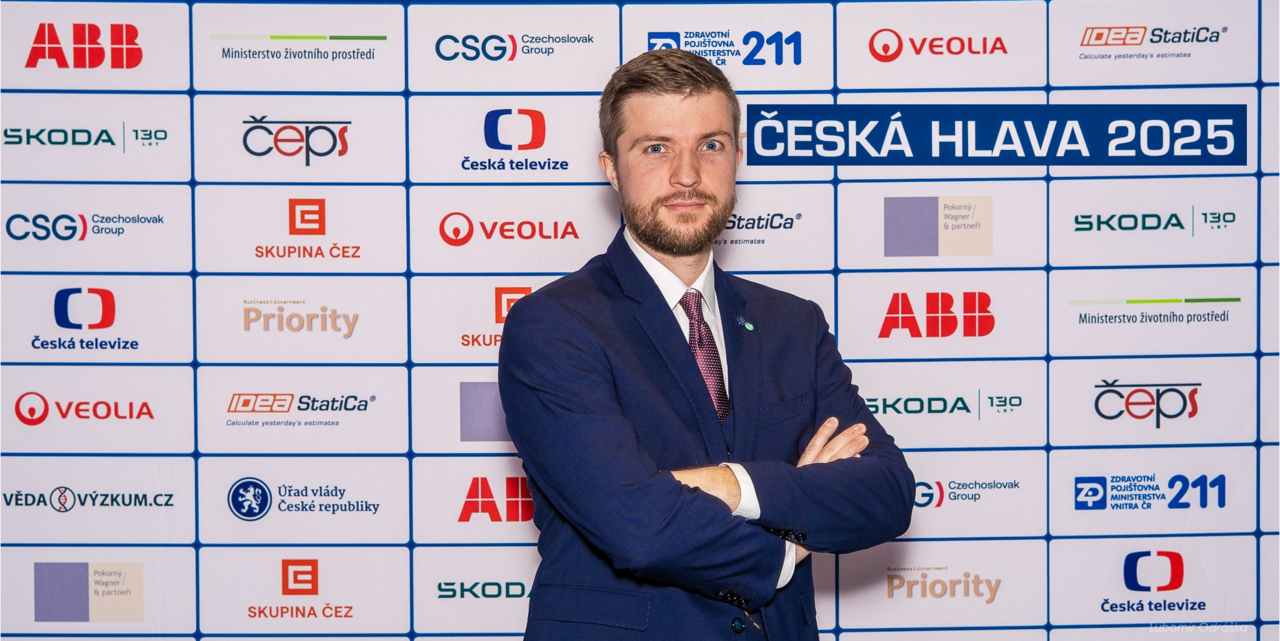
Martin Volek has been a postdoctoral researcher at the Chair of Organic Chemistry I since April 2025, where he is working on the chemistry of nucleic acids. Since October, this research stay has been sponsored by the Alexander von Humboldt Foundation, which has granted the award-winning young scientist a two-year fellowship.
Martin now has another reason to celebrate: for his extraordinary research achievements during his doctoral studies at the Institute of Organic Chemistry and Biochemistry of the Czech Academy of Sciences (IOCB CAS), he has received the highest Czech award for scientists and innovators in the category "DOCTORANDUS, VEOLIA Award for Natural Sciences": "Česká hlava" ("Czech Brain") 2025. The €2,000 prize was presented to him at a gala evening which was broadcastes nationwide on Czech television. The live stream with video clips is available as a recording in Czech:
https://www.ceskatelevize.cz/porady/10213906625-ceska-hlava/22554416014/ (from minute 4:30).
Aurora and Apollon
The jury of leading Czech scientists justified their choice as follows: "For the development of catalytically active DNA molecules - the deoxyribozymes Aurora and Apollon, which emit fluorescent and chromogenic signals and enable the detection of SARS-CoV-2 virus enzymes. The substances have the potential to support the development of new antiviral drugs." On the Česká hlava website(https://www.ceskahlava.cz/rndr-martin-volek-ph-d/), the research project is explained as follows:
The DNA molecule is known as the carrier of genetic information, and most of us think of it as a double helix. We often encounter the term DNA in detective stories, where DNA is discussed in connection with clues or evidence to convict a perpetrator.
DDNA is found in the cell nucleus and belongs to the group of nucleic acids. However, these substances can do much more than carry genes and convict criminals. A very unexpected and remarkable discovery was that nucleic acids can act as catalysts, i.e., accelerate chemical reactions. This discovery was made by Thomas Cech's group in the 1980s in the USA. Shortly thereafter, a method called in vitro selection was developed, which allows the identification of DNA or RNA molecules that catalyze the desired chemical reaction.
In vitro selection is essentially accelerated artificial evolution in a test tube. We can imagine it as sifting through a huge number of molecules and looking only for those with the right function. At first glance, it seems simple, but typical in vitro selection starts with a huge number of different DNA molecules. In words, there are ten to the sixteenth power (1016, ten million billions) of them, and only a few suitable molecules are sought among them. The incredible power of in vitro selection therefore lies in its precise ability to distinguish active molecules that can catalyze a given reaction from the inactive ones.
The awarded project introduces a new way of thinking about DNA. DNA is not seen as a carrier of genetic information, but as an organic compound capable of catalysing chemical reactions. In vitro selection was used to isolate short catalytically active DNA molecules (so-called deoxyribozymes) that produce fluorescent and coloured signals. These carefully selected DNA molecules were named Aurora, which produces violet fluorescence, and Apollon, which has a bright yellow colour.
A key achievement was the successful development of a sensor based on these DNAs.
This sensor produces a fluorescent signal exclusively in the presence of a specific and active enzyme from the SARS-CoV-2 virus. The name of the enzyme is the Nsp15 endoribonuclease. This sensor was then used in high-throughput screening to find suitable inhibitors of this Nsp15 endoribonuclease. The inhibitors discovered using this method could serve as the basis for the development of new antiviral therapeutics. Reliable and robust screening tests are one of the cornerstones of discovering new drugs in pharmacy.
The results of the work have shown that catalytically active DNA molecules are suitable for the development of high-capacity tests. Aurora and Apollon can thus be used both in basic research to find new drugs and as a basis for the development of a new generation of tests for the rapid and inexpensive diagnosis of certain viral diseases.
(Translation from Czech)
Additional images