Historic Background
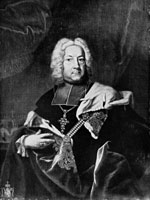
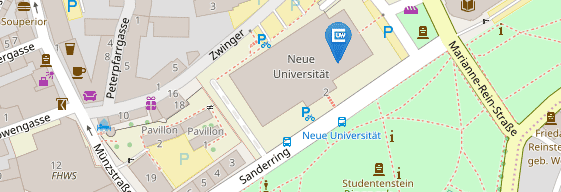
Prince-bishop Friedrich Karl von Schönborn (1674-1748) was not only an unparalleled builder and business promoter, but also a visionary who was a strong advocate of the natural sciences and medicine. He recognised the importance of chemistry for medicine very early on and stipulated in the University of Würzburg's study regulations of 1734 that medical students should also be taught chemistry. As a result, a hall was set up in the Juliusspital for the study of chemistry. The immense foresight of this measure becomes clear when one considers the status of chemistry at the time. In the 18th century, the subject led the modest status of an insignificant auxiliary science in disreputable proximity to fraudulent alchemical obscurity. As a completely new and unknown profession, there was no clear concept of chemistry. The rise of chemistry as a scientific, academic discipline was unstoppable and was documented by the appointment of Johann Georg Pickel as the first full professor at the University of Würzburg in 1782. As chemistry became increasingly important, the teaching responsibilities of the subject grew. In 1836, a second chair was therefore established in the Faculty of Medicine in addition to the Chair of Chemistry in the Faculty of Arts. Due to the lack of space in the Medical College building behind the Juliusspital, the Institute of Chemistry was opened at Maxstrasse 4 in 1865, which had room for 103 interns, six assistants, a private lecturer and two professors. But even this building was not long to fulfil the ever-increasing demands of the young discipline.
Professor Emil Fischer, who worked in Würzburg from 1885 to 1892, complained about the lack of space and the poor facilities, so a new building was approved in 1892. Emil Fischer drew up the design for the new building, but moved to his new place of work in Berlin in the same year.
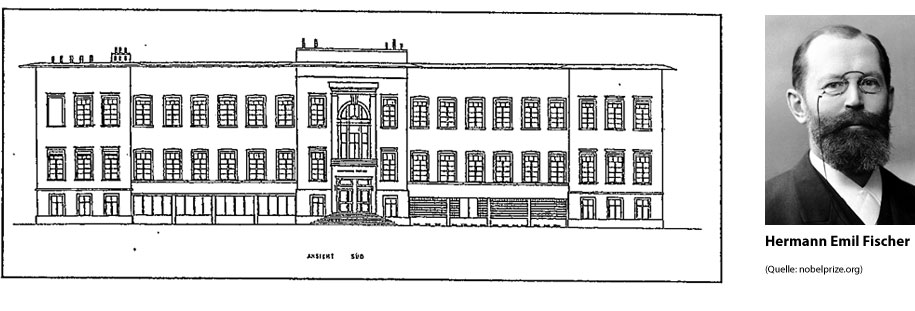
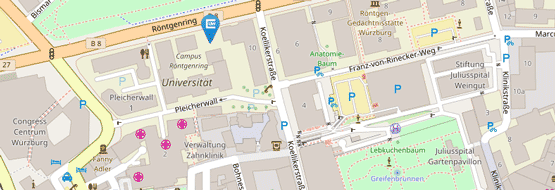
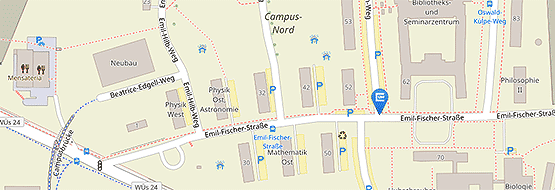
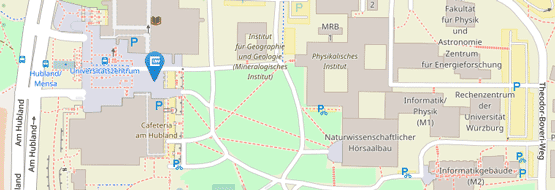
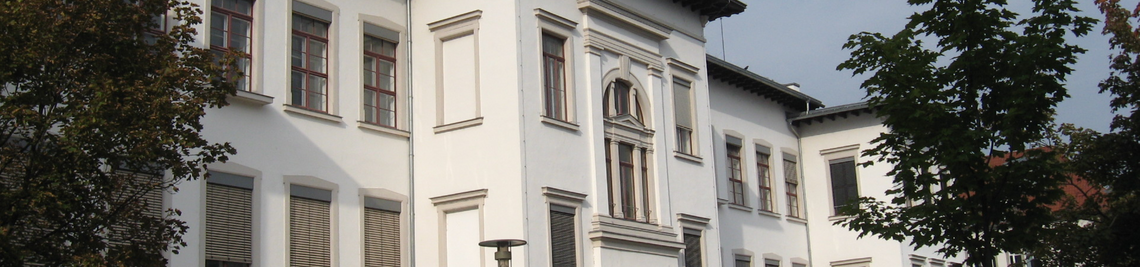
His successor, Professor Hantzsch, took over the realisation of Fischer's plans for the new Institute of Chemistry, which was built at Röntgenring 11. The new building, which was opened in a ceremony in 1896, was considered one of the best-equipped institutes in Germany. The building included a large lecture theatre and a three-story residential building for the institute's director and caretaker.The building was one of the few to survive the night of the fire on 16 March 1945, and the grass roof on the building prevented worse.With the development of Hubland as a new campus, Chemistry moves to the outskirts of the city from 1965. This ends the history of chemistry on Röntgenring for the time being. The establishment of the Chair of Chemical Technology of Material Synthesis and the Technology of Functional Materials degree programme in 2006 marked the beginning of a new chapter for chemistry at Röntgenring.