
Research Highlights
To provide an overview of our past research activities, we highlight a selection of key publications below, each accompanied by an accessible summary. Read on to learn more.
Jan Gerrit Horstmann, Christoph Emeis, Andrin Caviezel, Quintin N. Meier, Nicolas Wyler, Thomas Lottermoser, Fabio Caruso & Manfred Fiebig, arXiv:2508.16422
https://doi.org/10.48550/arXiv.2508.16422
“Work smarter, not harder!” We all know this saying. When it comes to manipulating the properties of quantum materials with light, however, it takes on a very literal meaning.
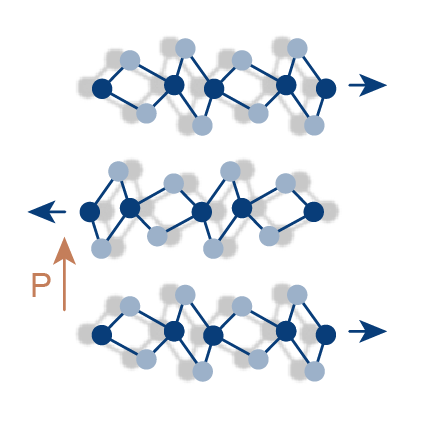
Many of the remarkable properties of quantum materials can be controlled by rearranging their atoms—in other words, by modifying their regular crystal structure. Femtosecond light pulses (1 femtosecond = one millionth of a billionth of a second) provide a powerful way to do this. Typically, such ultrashort pulses excite the negatively charged electrons in a material. As the electrons rearrange, they exert forces on the positively charged atomic nuclei, causing the atoms themselves to move.
In our work, we studied this light-induced atomic motion in a so-called sliding ferroelectric. When the material is illuminated with a femtosecond laser pulse, neighboring atomic layers are forced to slide against each other—much like rubbing the palms of your hands back and forth. This sliding motion has a strong influence on two key properties of the material: its ferroelectric order and its topology, both of which are highly attractive for robust information storage. In principle, the larger the relative motion between the layers, the better the control over these properties.
Surprisingly, simply increasing the strength of the light pulse does not help. At high excitation levels, the interlayer sliding actually becomes weaker, limiting our ability to control ferroelectricity and topology. The reason is that exciting too many electrons makes their spatial distribution more uniform. In this situation, the electrons no longer experience a force in a specific direction and therefore fail to drive further atomic motion.
This is where we chose to work smarter. Instead of using a single, stronger pulse, we split the light energy into two separate pulses with a controlled time delay between them. After the first pulse, we wait for the electrons to relax and then excite the system again. In this way, the atomic motion induced by each pulse adds up, allowing us to surpass the limitations of single-pulse excitation.
Our results point toward new strategies for energy-efficient control and switching of technologically relevant properties, such as ferroelectric polarization, even in materials that are only a few atomic layers thick.
Jan Gerrit Horstmann, Ehsan Hassanpour, Aaron Merlin Müller, Yannik Zemp, Thomas Lottermoser, Yusuke Tokunaga, Yasujiro Taguchi, Yoshinori Tokura, Mads C. Weber & Manfred Fiebig, Nature Communications 16, 6802 (2025)
https://doi.org/10.1038/s41467-025-62158-2
For thousands of years, swordsmiths have relied on a remarkably effective technique to produce high-quality blades: immediately after forging, the red-hot sword is rapidly cooled in a bath of water or oil. In steel, this process—known as quenching—freezes in a particular microscopic domain structure. If the metal were cooled slowly instead, these domains would have time to rearrange and grow, often resulting in inferior mechanical properties.
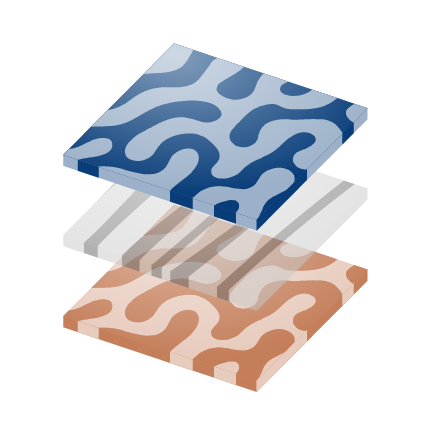
In our study, we asked what happens if a similar idea is applied to a quantum material—in our case, a so-called multiferroic. Multiferroics are materials in which at least two different types of ferroic order coexist, such as ferromagnetism, antiferromagnetism, ferroelectricity, or ferroelasticity. The balance between these orders is often delicate, meaning that even small changes in temperature can lead to dramatic transformations, including the formation of entirely new domain patterns.
This sensitivity is particularly interesting because domains in multiferroic materials are promising candidates for extremely energy-efficient information storage. The key question we explored was whether it is possible to freeze in a specific ferroic domain pattern—much like in quenched steel—and preserve it as the material is driven into a different phase.
At the ultralow temperatures relevant for our experiments, plunging a sample into water is, of course, not an option. Instead, we use a laser to gently heat the material and then abruptly block the laser light. This allows us to cool the sample at rates exceeding 300 °C per second.
Using this approach, we find that magnetic domain patterns can indeed be frozen in and carried over into a multiferroic phase where such patterns would normally not be allowed. Our results show that deliberately driving materials out of their comfort zone can stabilize new and unexpected states. These nonequilibrium states may offer exciting opportunities for future information-storage technologies.
Hannes Böckmann, Jan Gerrit Horstmann, Felix Kurtz, Manuel Buriks, Karun Gadge, Salvatore R. Manmana, Stefan Wippermann & Claus Ropers, Nature Physics 21, 1106 (2025)
https://doi.org/10.1038/s41567-025-02899-5
Have you ever tried to pick up something tiny—like a needle—while wearing thick winter gloves? It quickly becomes frustrating: the tool you are using is simply much larger than the object you want to manipulate.
A similar challenge arises in many experiments where light is used to control material properties. One such property is the formation of domains—regions within a material where certain characteristics are uniform. These functional domains can be extremely small, sometimes much smaller than the wavelength of light itself. In these situations, just like with the glove and the needle, it becomes difficult to target and control individual domains using light.
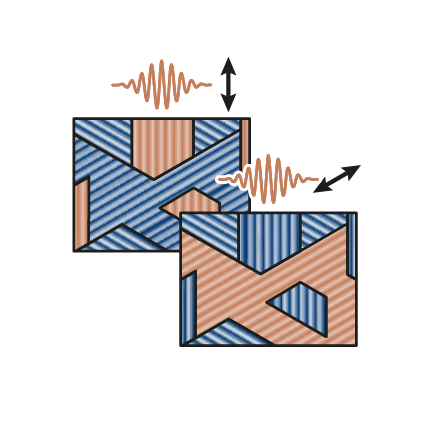
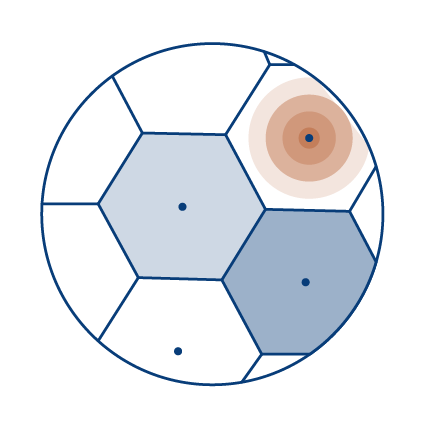
In this study, we demonstrate a way to control nanometer-sized metallic and insulating domains using light whose wavelength is orders of magnitude larger than the domains themselves. The key is to lower the energy of the photons in the light pulse, which allows us to selectively excite only those nanometer-scale domains that are oriented along specific directions—without inadvertently depositing energy into neighboring domains with different orientations.
By additionally changing the polarization of the light, we gain further control and can choose which domains are excited. In this way, the degrees of freedom of light—such as wavelength and polarization—become powerful control knobs.
Our results show that, by carefully tuning these properties, light can act like a new kind of optical tweezers: precise enough to grab nanoscale objects, even when our “hands” are effectively wearing gloves.
Felix Kurtz, Tim N. Dauwe, Sergey V. Yalunin, Gero Storeck, Jan Gerrit Horstmann, Hannes Böckmann & Claus Ropers Nature Materials 23, 890 (2024)
https://doi.org/10.1038/s41563-024-01880-6
Energy conversion in functional materials can sometimes feel a bit like dealing with bureaucracy: you invest a lot of effort, much of it gets lost along the way, and the final outcome is often less than you hoped for.
In physical terms, this happens because optical excitation with femtosecond laser pulses typically triggers a cascade of energy-conversion processes. Energy is first deposited into photoexcited electrons, then transferred to other electrons, from there to lattice vibrations, and finally redistributed through scattering among different vibrational modes. Only a small fraction of the original energy may end up in the specific degree of freedom one actually wants to control—for example, a particular type of atomic motion.
This cascade of scattering processes can be thought of as a form of microscopic friction. It plays a crucial role in determining how and where heat is generated, transported, and dissipated, and thus strongly affects the performance of electronic devices. Understanding the pathways taken by energy after it enters a material is therefore essential.
In our work, we use ultrafast low-energy electron diffraction to directly track how the energy of a femtosecond laser pulse is transformed, step by step, into structural motion and ultimately into heat. This technique is particularly sensitive to the first one or two atomic layers of a material, allowing us to study energy flow precisely where many technologically relevant processes take place.
In the long term, insights gained from studies like this could guide the design of new materials that enable more energy-efficient processors, support higher clock rates, and ultimately lead to faster and more powerful electronic devices.
Jan Gerrit Horstmann, Hannes Böckmann, Bareld Wit, Felix Kurtz, Gero Storeck & Claus Ropers, Nature 583, 232 (2020)
https://doi.org/10.1038/s41586-020-2440-4
It is one of those classic childhood memories: sitting on a swing while someone pushes at just the right moments to make you swing higher and higher. Timing is everything. A well-timed push amplifies the motion, while a push at the wrong moment does little or nothing at all.
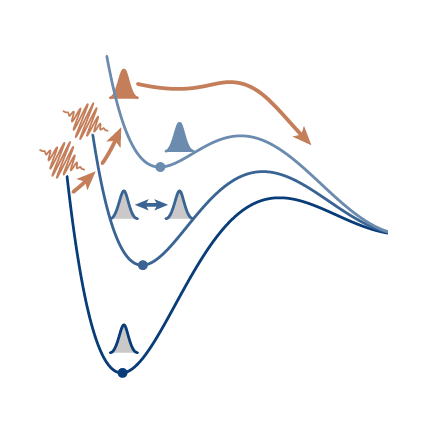
Can a similar principle be applied to atoms? In our work, we show that it can. We demonstrate that atoms at a surface can be set into a controlled back-and-forth motion, and that repeatedly reinforcing this motion with precisely timed “pushes” can be used to control a phase transition between an insulating and a metallic state.
To achieve this, we use sequences of femtosecond laser pulses—bursts of light lasting only a millionth of a billionth of a second—to repeatedly excite coherent phonons. These phonons are collective vibrations in which atoms move in a synchronized way across many thousands of repeating units in a material. When the timing between successive laser pulses is matched to the natural oscillation frequency of the atoms, their motion grows stronger with each pulse.
Much like a rollercoaster gaining speed to crest a hill, this amplified atomic motion allows the system to overcome the energy barrier separating the insulating and metallic phases. Crucially, the transition is driven by the directed motion of atoms, rather than by heating the material.
Our results point toward new ways of switching material properties that are more energy-efficient and open the door to accessing novel states of matter that cannot be reached under normal equilibrium conditions.